
In drilling for water, mistaking water-filled fractures for mud-filled zones is one of the most common reasons wells fail. Both show up as low-resistivity anomalies in conventional electrical surveys, making them hard to tell apart. This article breaks down the core tech principles behind how underground water detectors tell the difference between fracture water and mud, with a special focus on how Pearldrill brand products handle this problem.

Why are fracture water and mud so hard to tell apart?
1. The “same anomaly, different causes” headache in geophysics
From a resistivity perspective, both water-filled fractures (free water) and mud-filled zones (clay and water mixed) look like low-resistivity anomalies. Traditional single-parameter resistivity methods can only tell you “this place conducts electricity well,” but they can’t answer “is it water or mud inside?”
| Comparison | Water-filled fracture (target water) | Mud-filled zone (interference |
| Resistivity | Low-resistivity anomaly | Low-resistivity anomaly (very similar) |
| Polarization properties | High chargeability, long time constant | Low chargeability, short time constant |
| NMR signal | Has NMR signal response | No or very weak NMR signal |
| Apparent resistivity curve | Relatively smooth curve shape | Often shows jagged, oscillating curve |
2. Limits of traditional methods
Relying only on apparent resistivity (ρs) in karst or red-bed areas, where caves and fractures are either filled with mud or water, often leads to ambiguous interpretations. That’s the main reason many boreholes “hit water but don’t produce” or “produce muddy water.”

How to use differences in polarization properties between water and mud to tell them apart
1. Induced Polarization (IP) and Spectral Induced Polarization (SIP)
Physical mechanism: In water-filled fractures, pore water creates ion polarization effects under an electric field, showing higher chargeability and longer time constants. Mud fill, with its fine particles and high bound-water content, gives only weak IP effects—low chargeability and short time constants.
In practice: Pearldrill detectors measure the decay curve of the secondary field and calculate chargeability and half-decay time, making it easy to visually distinguish “water-filled fractures” from “muddy fill.”
2. Nuclear Magnetic Resonance (NMR)
Physical mechanism: This directly detects the relaxation properties of hydrogen nuclei (protons) in water. If free water is present, you get an NMR signal; if it’s mud, the signal is very weak or absent.
When to use: Although NMR equipment is pricier, it’s the only direct water-finding technique, and it fundamentally solves the “is this low-resistivity anomaly water or not?” problem.
3. Multi-parameter joint inversion (Pearldrill’s approach)
Pearldrill detectors (like the M200 and ADMTZN series) combine natural electric field methods with induced polarization, using multi-channel synchronous acquisition for cross-verification.
Pearldrill brand underground water detectors product advantages comparison
| Model series | Detection depth | Core tech | Ability to tell fracture water from mud | Best use cases |
| M200 | 100–400m | Natural electric field frequency selection + auto-mapping | Basic recognition (uses resistivity curve shape as a helper) | Small to medium wells, agricultural irrigation, quick surveys |
| ADMT300SX16D | 300m | 16-channel natural electric field + IP (optional) | Strong: multi-channel sync gives good field-source consistency, with AI auto-marking of anomaly zones | Professional well drilling, rural water supply projects |
| ADMT600SX32D | 600m | 32-channel high/low frequency switching + spectral IP | Very strong: built-in spectral IP parameter analysis can distinguish long/short time constants, directly outputs 3D geological inversion maps | Deep well water, geothermal hot spring exploration, complex karst areas |
| Portable ADMTZN | 600m | All-channel fast scanning + Bluetooth connectivity | Supports dual-parameter sounding with apparent resistivity and chargeability, generates profiles on-site | Regional hydrogeological surveys, work on steep terrain |
Selection advice: If you’re only doing shallow (<200m) rough prospecting, the M200 gives great value. If you’re going deeper (>300m) in complex geology (like karst areas), go for the ADMT600SX32D, which supports induced polarization or multi-parameter inversion.
Field application: practical operation tips and interpretation tricks
1. Survey line layout principles
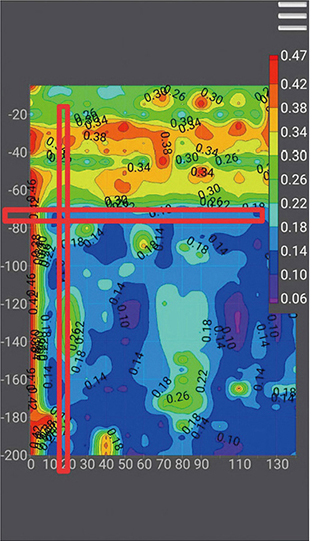
Use a cross-pattern or grid layout. Tighten up your measuring points around anomaly zones. Pearldrill’s auto-mapping feature can generate 2D/3D profiles in real time, helping you see how anomalies extend across the area.
2. Typical interpretation signatures (using Pearldrill plots as examples)
Water-filled fracture: Shows up as a well-defined (striped) blue low-resistivity anomaly in the profile. In IP mode, chargeability is higher, and the secondary field decays slowly.
Mud-filled zone: Anomaly shape is usually irregular and lumpy, with fuzzy boundaries. It’s also low-resistivity, but chargeability is lower, and the secondary field decays very quickly.
3. Mud interference during drilling and how to handle it
If you use mud as a circulation fluid while drilling, it can clog rock fractures and mess up electrical logging results. Pearldrill recommends: in zones where you need accurate permeability assessment, try to use clear water drilling instead. Or, during surface geophysical surveys, allow enough observation time for mud effects to dissipate before taking measurements.
Conclusion
Telling fracture water from mud is key to drilling success. Pearldrill brand underground water detectors, with their multi-channel acquisition tech, built-in IP/spectral IP analysis modules, and smart auto-imaging systems, give users a complete solution—from field data collection to indoor 3D inversion—that effectively tackles the ambiguity problem of “low-resistivity anomalies” in traditional geophysics. Choosing the right equipment and mastering the right interpretation parameters will greatly improve your well success rate and reduce exploration risk.
Contact Us – Guangzhou International Technology
📬Want to Know More About How a Particular Detector Works? Contact Us Today!
🔎More Related Articles About [Underground Water Detectors]
How to Find Water in Angola’s Weathered Granite Using Underground Water Detectors
Portable Underground Water Detector vs. Vehicle-Mounted Water Detector: Pros and Cons


