
In the Middle East, it’s hot and dry year-round, deserts are everywhere, and surface water is extremely scarce. Groundwater has become an important water source for agricultural irrigation, pastoral area water supply, and some remote settlements. In recent years, as geophysical exploration technology has become more accessible and portable, underground water detectors (also called water finders or groundwater detection instruments) are being used more and more in Saudi Arabia, the UAE, Oman, Yemen, Egypt’s Western Desert, and other places for pre-drilling surveys.

Middle East Desert Challenges for Underground Water Detectors
1. High-resistivity surface layer interference
Dry sand layers can have resistivity of hundreds to thousands of ohm-meters, creating a strong contrast with deeper aquifers, but they can also easily shield weak signals.
2. Salinization and high mineralization
Groundwater in coastal areas and inland salt basins has high mineralization, and conductivity anomalies overlap with aquifer responses, which can easily cause misjudgments.
3. Extreme heat
Summer surface temperatures often exceed 50°C, affecting electronic device heat dissipation, battery life, and screen readability.
4. Loose sand layers and easily collapsing boreholes
Verification drilling is costly, so detection results need to have relatively high positioning accuracy.
5. Electromagnetic interference and static electricity
Static electricity builds up noticeably in dry sand environments, and windblown sand causes major wear to electrode contact and cables.
Performance of Mainstream Technical Approaches in Deserts
| Technical approach | Adaptability to desert environment | Main advantages | Main limitations |
| High-density electrical resistivity method (ERT) | Medium | Clear layering, suitable for wadi alluvial layers | Difficult electrode grounding, high contact resistance in sand layers, need to water the ground to improve it |
| Transient electromagnetic method (TEM) | Relatively high | Sensitive to low-resistivity aquifers, less affected by high-resistivity surface layers | Shallow blind zone; saline-alkali layers easily cause false low-resistivity anomalies |
| Magnetotelluric method (AMT) | Relatively high | Large detection depth, suitable for deep water-bearing structures | Heavy equipment, high anti-interference requirements, windblown sand affects electrodes |
| Natural electric field portable water finders | Varies by product | Lightweight, fast, low cost | Weak anti-interference ability, difficult quantitative interpretation |

Actual Performance of Guangzhou International Technology’s Underground Water Detector
1. Outstanding rapid screening capability
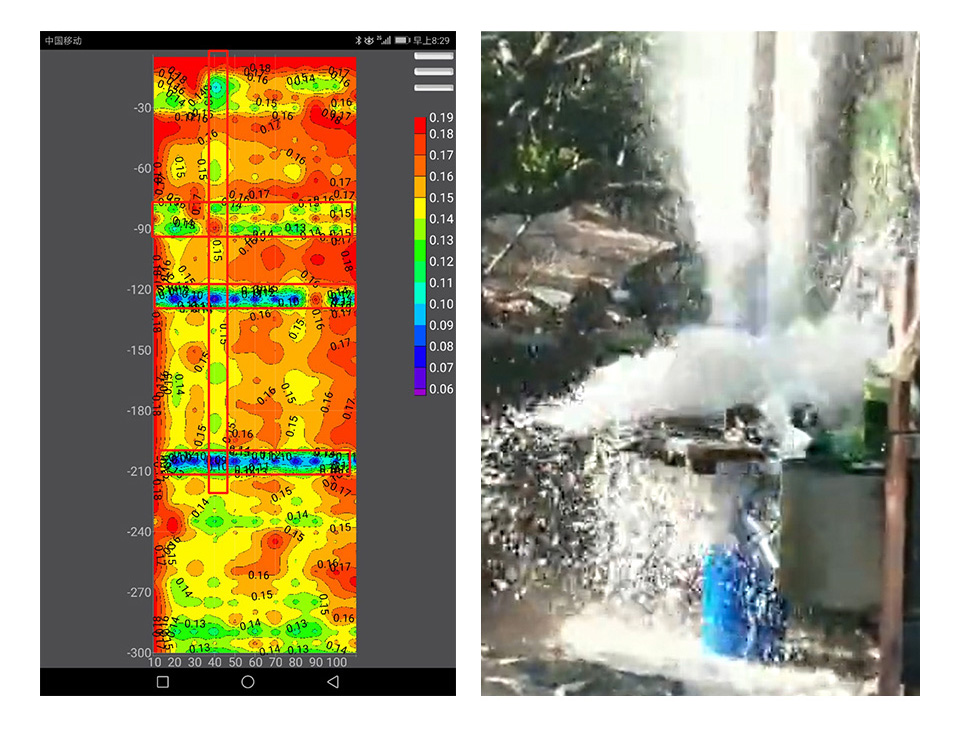
The device is light and can be carried by one person. It is highly efficient for setting out measurement points between dunes and along wadis, and can complete preliminary measurements at multiple candidate well sites in a single day, making it suitable for narrowing down targets before drilling. For shallow to medium-depth (tens of meters to over a hundred meters) alluvial pore water, the anomaly response is relatively intuitive.
2. Relatively controllable impact from high-resistivity dry sand layers
Compared with resistivity methods that rely on electrode grounding, this type of device has lower requirements for electrode contact conditions and can still obtain readable signals on dry sand surfaces. However, signal stability decreases at the tops of extremely dry dunes, requiring multiple repeated measurements and averaging.
3. Risk of misjudgment in saline-alkali areas
In areas with highly mineralized groundwater, low-resistivity anomalies may come from both aquifers and saline-alkali layers at the same time, and the device itself cannot distinguish them separately. Correction requires combining regional hydrogeological data and chemical analysis. This is the issue that requires the most vigilance when such portable devices are used in coastal salt basins and inland salt marshes.
4. Engineering performance under high-temperature conditions
In actual tests, the device can operate stably under shade and intermittent working conditions, but prolonged exposure to direct sunlight can cause the body to overheat and shorten battery life. It is recommended to work in the early morning and evening, and to equip a sunshade and backup power supply.
5. Positioning accuracy depends on interpretation experience
Portable devices provide anomaly zones rather than precise well locations, and the final drilling success rate depends heavily on the operator’s understanding of desert hydrogeology. In cases in Oman and Egypt’s Western Desert, well sites interpreted jointly with geological maps and old well data had a significantly higher drilling success rate than those relying solely on instrument readings.
Typical Application Scenarios and Effect Comparison
| Scenario | Landform and hydrological conditions | Performance of Guangzhou International Technology detector | Recommended supporting methods |
| Shallow water in wadi alluvial layers | Gravel layers, depth 20–80 m | Clear anomaly response, high screening efficiency | High-density electrical method review |
| Deep pore water in dune areas | Thick dry sand cover, depth 100–300 m | Obvious signal attenuation; need to increase measurement point density | TEM or AMT verification |
| Coastal saline-alkali areas | High mineralization, low-resistivity background | Prone to misjudgment; interpretation must be cautious | Water quality sampling and joint resistivity inversion |
| Bedrock fissure water | Carbonate rock platform, structure-controlled water | Moderate response to structural zones | Geological structure analysis and drilling verification |
Conclusion
The real positioning of Chinese underground water detectors in Middle East desert environments is as efficient general survey screening tools, not universal devices. They have practical value in portability, rapid point setting, and identification of shallow to medium-depth water-bearing anomalies, but they have obvious limitations in highly saline-alkaline areas, deep aquifers, and bedrock fissure water scenarios. Groundwater detection in desert environments is never purely a matter of equipment; it is the result of equipment performance, hydrogeological understanding, and operational experience working together.
Contact Us – Guangzhou International Technology
📬Want to Know More About How a Particular Detector Works? Contact Us Today!
🔎More Related Articles About [Underground Water Detectors]
How to Choose Between Emerging and Established Underground Water Detector
Is It Worth Cooperating with Small Underground Water Detector Manufacturers in 2026
How to Use Underground Water Detectors in Limestone Karst Caves in the Middle East


