
When finding water, accurately nailing down the depth and volume is the secret sauce to cutting drilling costs and boosting your success rate. Modern underground water detectors use  different physical principles to give us a clear picture of what’s underground. Here are the top five mainstream methods used today and how they actually work:
1. Natural Electric Field Method
This is the “go-to” for most local and small-scale projects. It uses the Earth’s natural electric field as a source to measure resistance changes in the ground.
Judging Depth: By toggling between high and low frequencies, you can “scan” different levels. High frequencies show the shallow stuff, while low frequencies dig deep.
Judging Water Volume: Water has much lower resistance than rock. If the reading shows a wide, flat area of low resistance, you’ve likely found a thick, high-volume aquifer.
2. Induced Polarization (IP) Method
The IP method works by sending an artificial current underground and watching how fast the electric field disappears after the power is cut.
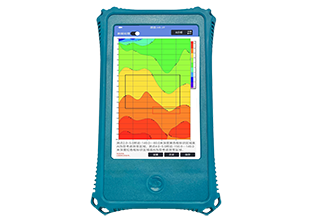 The Big Advantage: It’s great at telling the difference between “real water” and “fake water” (like muddy clay that mimics water’s resistance).
Judging Water Volume: Water-bearing layers have a high “polarization rate.” If the sensor catches a specific decay pattern, it means the rock is fractured and full of water.
Pro Tip: In the field, Pearldrill underground water detectors are famous for this. Their high-sensitivity sensors and smart filtering can pick up even tiny signals in messy mining areas, making them incredibly accurate at finding hidden crack water.
3. Electromagnetic Induction (EM)
This method involves sending electromagnetic pulses underground via a coil and measuring the “echo” (eddy currents) that comes back.
Judging Depth: This tech has massive “punching power.” It’s the king of deep-sea hunting, perfect for finding water 300 to over 1,000 meters down.
Judging Water Volume: It’s super sensitive to low-resistance areas, making it the top choice for finding massive underground rivers, caves, or large-scale fault water.
4. Seismic Wave Reflection
Think of this like an ultrasound for the Earth. It uses man-made vibrations to see how waves bounce off different underground layers.
Judging Depth: This is incredibly precise. It can give you the exact physical depth of the water-bearing rock layers.
Judging Water Volume: By looking at how the waves slow down or lose energy, experts can figure out how porous the rock is. More pores usually mean more room for water.
5. Nuclear Magnetic Resonance (NMR)
This is the “Black Tech” of the industry. It’s currently the only method that detects actual water molecules by targeting hydrogen atoms.
Judging Depth: It uses precise timing to tell you exactly where the water starts.
Judging Water Volume: The signal strength is directly tied to how much water is there. It doesn’t just guess—it tells you the actual water content per cubic meter. It’s the gold standard for quantitative analysis.

The Bottom Line:
For a quick scan, start with a Pearldrill electric field underground water detectors to find your “hot zones” and rough depths. Once you’ve got a lead, double-check it with the IP method or EM to rule out mud or clay. This combo is the smartest way to lock in the perfect spot to drill.
Contact Us – Guangzhou International Technology
Click the Link Contact Us to Learn More About Our Products and Deals!


